
G456
/ G556 Astrogeology
Spring
2019
A. Ruzicka

e-mail: ruzickaa@pdx.edu
 |
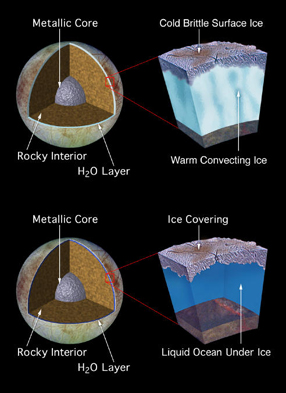 |
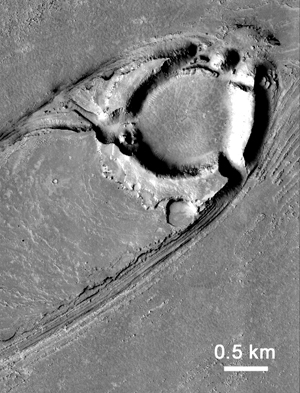
Water, water, everywhere! "Pendant
crater" on Mars (left) recording evidence for massive flooding (current
from upper right to lower left); two interior models for Europa (right),
which contains a crust of water ice that may overlie a subsurface ocean.
Images courtesy of NASA.
Course information
- Syllabus (posted 3/27/2019)
- Links to current and recent space missions The link leads to a page on the instructor's website.
- I will be making available handouts of the course Powerpoints on D2L. You can access D2L using your regular PSU login. (posted 3/27/2019)
- For Labs 3 and 4 (Mars 1 and 2), you will need to receive data sticks from me, which are taking longer to produce than typical and which should be available by class next Wednesday. For these labs we will be using a stripped down version of ArcView that contains Mars data. Before attempting these labs, you should read these instructions on how to use ArcView and the datasticks. It is important to follow these instructions exactly. Depending on hardware and software changes to computers, however, the actual procedure may differ from those given here. (posted 4/19/2019)
Laboratory Exercises
- Lab 1 Lab period 4/12/2019, due 4/19/2019. (posted 3/27/2019)
- Lab 2 Lab period 4/19/2019, due 4/26/2019. (posted 4/10/2019)
- Lab 3 Lab period 4/26/2019, due 5/3/2019. Before attempting this lab, please review this page on how to use ArcView and the data sticks. (posted 4/19/2019)
- Lab 4 Lab period 5/3/2019, due 5/10/2019. Before attempting this lab, please review this page on how to use ArcView and the data sticks. (posted 4/29/2019)
- Lab 5 Lab period 5/10/2019, due 5/17/2019. (posted 5/10/2019)
- Lab 6 Lab period 5/17/2019, due 5/24/2019. (posted 5/10/2019)
Problem sets (G556 students only)
- Problem set 1 Due by start of class, 5/6/2019. (posted 3/27/2019)
- Problem set 2 Due by start of class, 6/5/2019. (posted 5/17/2019)
Score distributions and answer keys
- Exam 1 (posted 5/3/2019)
- Exam 2 (posted 6/1/2019)
- Lab (posted 6/13/2019)
- Final Exam and Total Score (posted 6/13/2019)
Images from planetary analog field trips to SE Oregon
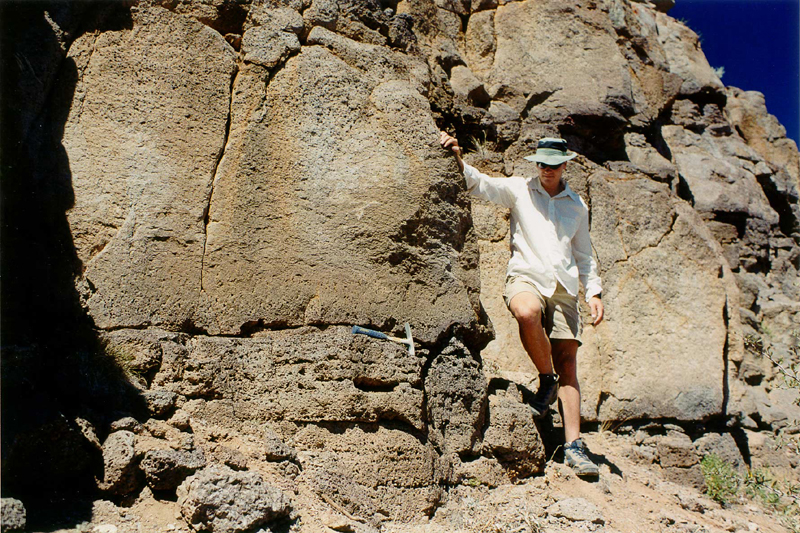
- Multiple flows of basaltic andesite on Steens Mountain; a hammer marks the contact between two flows. Vesicle content changes with respect to flow margins, being higher at the tops of flows and in narrow, chilled flow bottoms. Andesitic flows may be present on Mars.
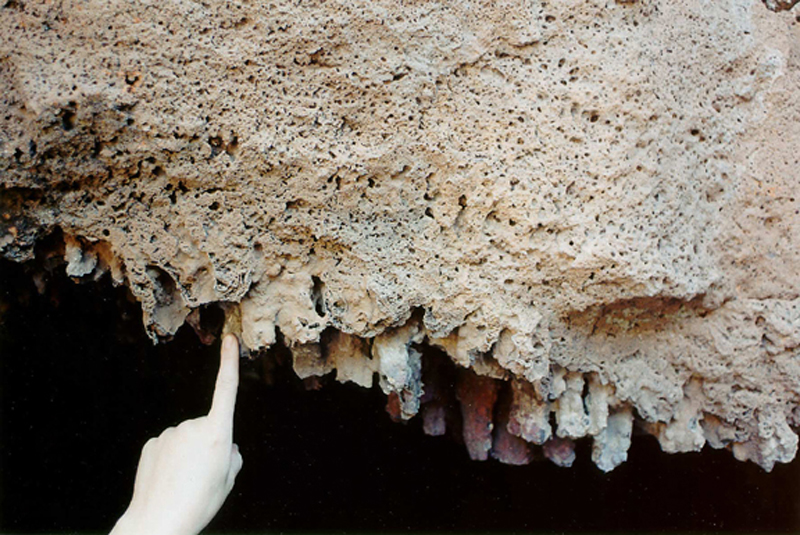
- Lava stalactites in basalt at edge of skylight in roof of lava tube, Diamond Craters Outstanding Natural Area. Note the obvious vesicles. Basalt flows are common on Earth, the Moon, Mars, Venus, probably Mercury, and on some asteroids. Probable skylights have been identified on Mars.
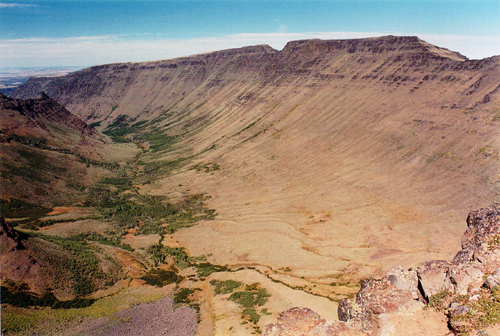
- Kiger gorge on Steens Mountain, showing U-shaped topographic profile indicative of glaciation. The headwalls of this canyon extend up to the alpine climate zone, but glaciers last resided on Steens Mountain over 10,000 years ago. U-shaped valleys are found on Mars.
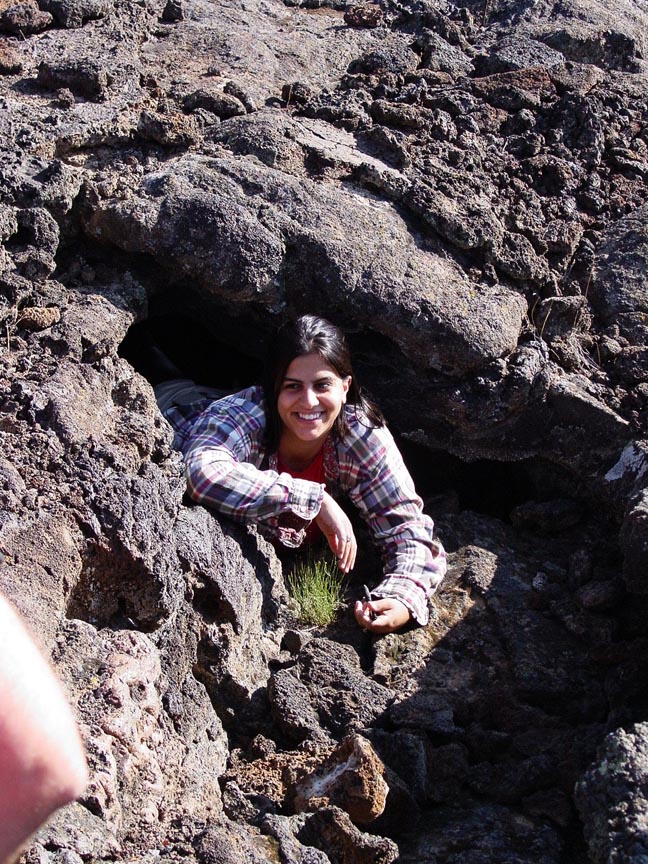
- Crawling in a lava tube at Diamond Craters Outstanding Natural Area, Kelly shows her stuff. The lava tube is a small analogue of sinuous rilles on the Moon, Mercury, Mars, and Venus, which probably once contained lava flowing either in tubes whose roofs collapsed or in open channels.
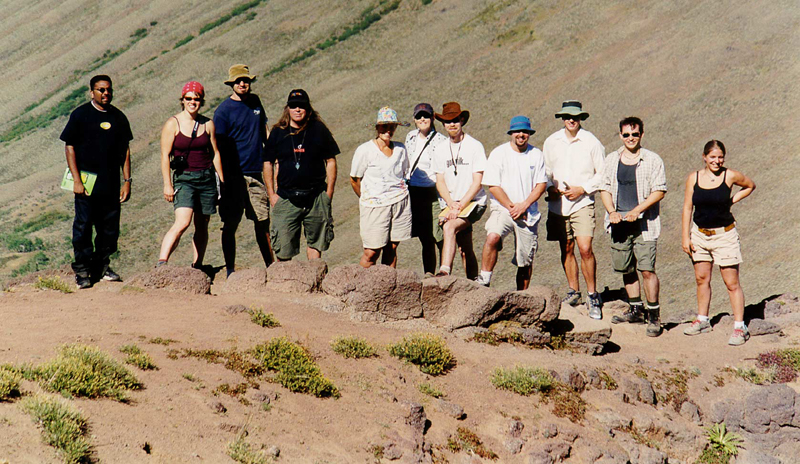
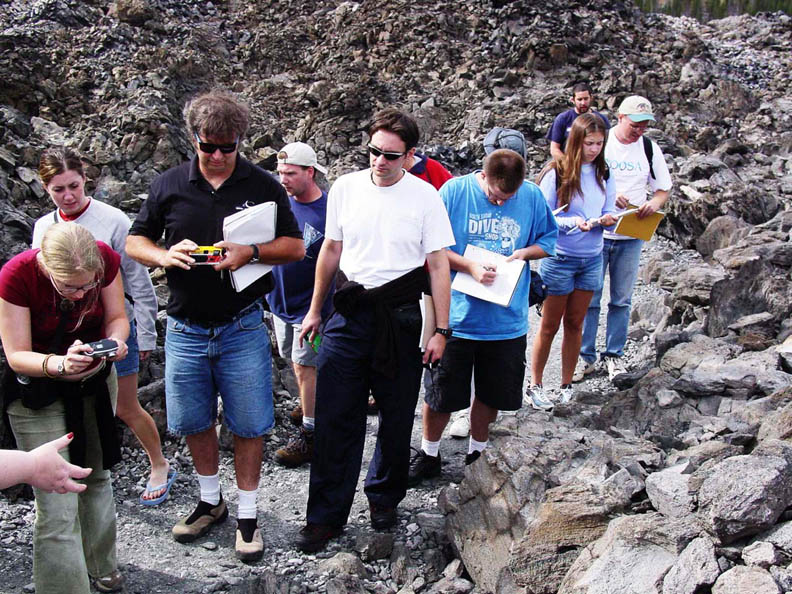
- Astrogeology students explore Big Obsidian Flow in Newberry National Monument. Big Obsidian Flow is composed of rhyolitic glass that was extruded as a pasty flow. Similar material may have been erupted on Venus.
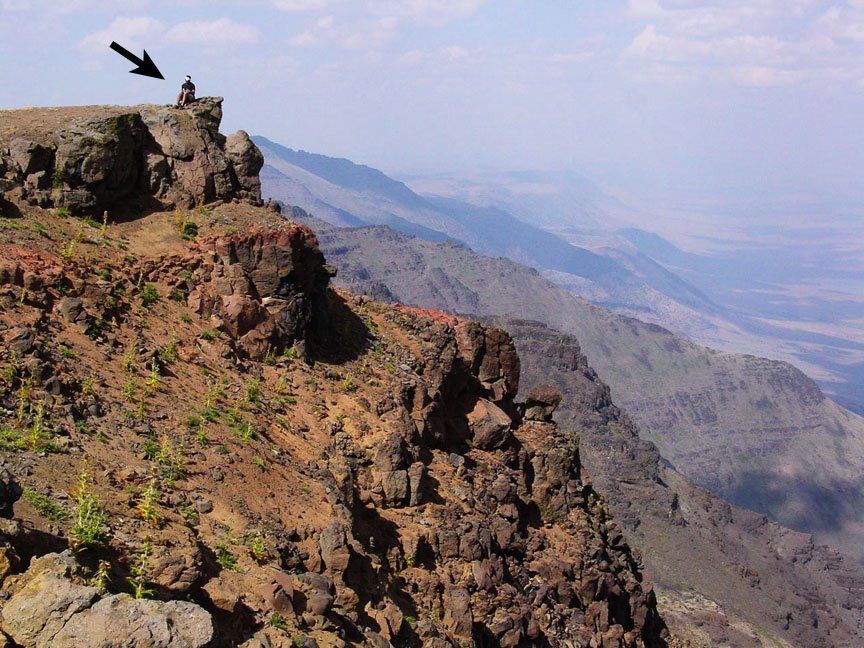
- Sitting on the brink (see arrow of Adolpho for scale) of the steep eastern scarp of Steens Mountain is a good place for contemplating the huge fault scarps that are present on various solar system bodies. Most of these scarps were produced by normal faulting.
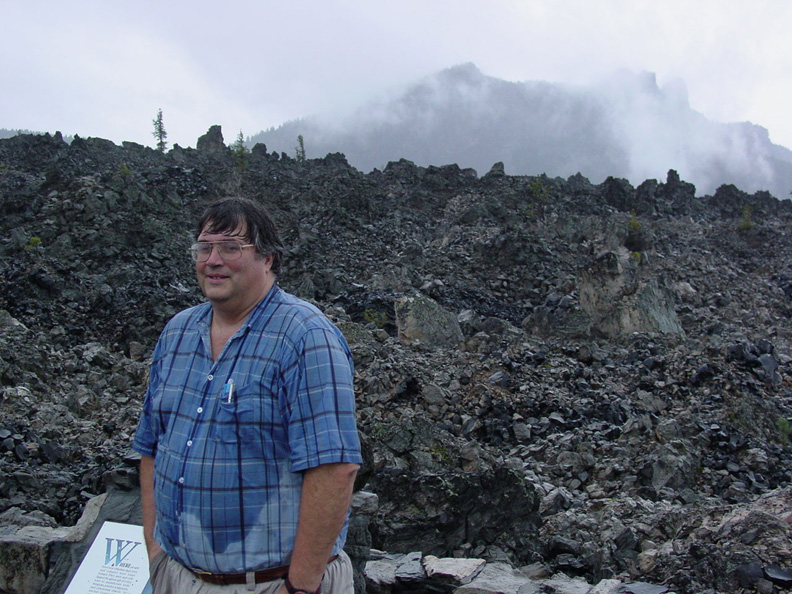
- DeWitt takes in stride the rain at the top of Newberry volcano, perhaps appreciating the uniqueness of planet Earth in this regard. A hydrocarbon rain appears to occur on Saturn's moon Titan.
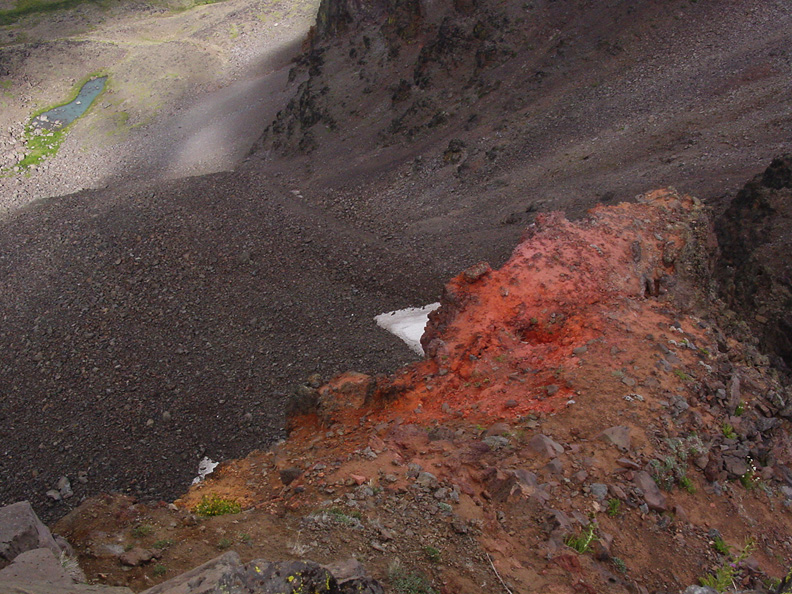
- Reddish-colored soil near the summit of Steens Mountain formed as the heat from lava flows baked underlying soil to create iron oxide minerals. Similar minerals and coloration are present on Mars.
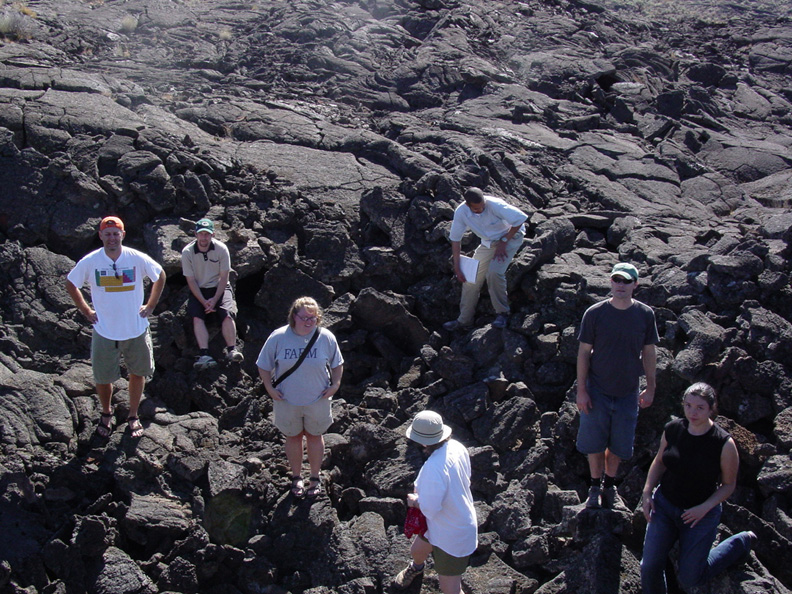
- Astrogeology students clamber over recently-formed pahoehoe lava flows at Diamond Craters. This landscape in southeast Oregon resembles the scene at some of the Venera landing sites on Venus.
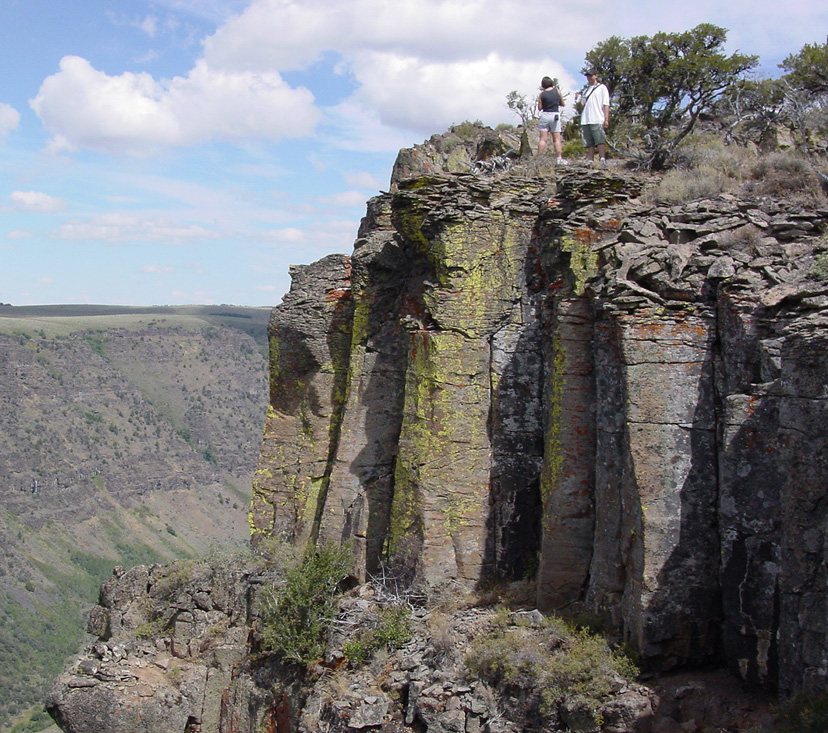
- Rock
columns below the feet of Stacie and Jeremy in the walls of Little Blitzen
gorge on Steens Mountain formed as a lava flow cracked during cooling.
Such columnar jointing is common on Earth, has been discovered on Mars,
and is probably present on other planetary bodies.
Last Updated: June 13, 2019