|
Research Areas
|
|||||||||
| Mitochondrial genome evolution and systematics of arachnids
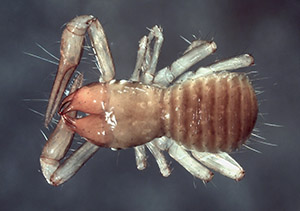
Arachnids are one of the major groups of arthropods, and have a diversity of behaviors, lifestyles, and features that make them fascinating organisms to study. Arachnids are also one of the most species-rich groups of organisms, but have not been nearly as well-studied as some of their arthropod kin. We seek to determine the systematic relationships among the 11 orders of this ancient group of chelicerates by utilizing information from mitochondrial genomes. We are finding that some of their mitochondrial genomes have quite unusual features, and that they encode some of the smallest transfer RNA genes known. Learn more about these charismatic chelicerates and this NSF-funded project by clicking on the Ricinuleid illustration to the left. |
|||||||||
![]() |
|||||||||
| Evolution of mitochondrial transfer and ribosomal RNAs
The transfer RNA genes in the mitochondrial genomes of spiders appear to be quite unusual. Most of the 22 tRNA genes have sequences that lack the ability to form the cloverleaf-shaped secondary structures found in typical tRNAs of other organisms. Instead, they often lack the sequence to encode the T arm, and apparently also the sequence for the 3' aminoacyl acceptor stem. How such unusual tRNAs can function is unknown. We are investigating whether a posttranscriptional RNA editing mechanism exists that can repair these tRNAs, and whether the mitochondrially encoded ribosome has also been modified to allow correct protein synthesis. |
|||||||||
![]() |
|||||||||
|
Morphological and genetic divergence of Habronattus oregonensis
Habronattus oregonensis jumping spiders inhabit the western U.S., typically in montane habitats. There is marked geographic variation in the coloration of males, but not of females. We are in the process of discovering and describing the extent of this morphological variation, as the range and variation of this species has not been extensively examined. We seek to determine whether the geographic variation is due to selection, and if so, whether it is natural selection or sexual selection due to female choice. We are doing this by combining observational studies of male variation and habitat variation with studies of variation in molecular markers. |
|||||||||
![]() |
Diversification and phylogeography of jumping spiders on sky islands
The isolation of populations on islands has resulted in the diversification and speciation of many organisms. Mountain peaks and ranges can act as islands of habitat, and in the southwestern U.S. are called "sky islands." Some species of jumping spiders that currently reside on these mountains have evolved distinct geographic variation in their behavior and morphology. In conjunction with Wayne Maddison, I have studied both the phenotypic changes and neutral genetic changes in mitochondrial loci that have accompanied isolation of these spiders. We have found evidence that sexual selection has been driving phenotypic diversification in Habronattus pugillis jumping spiders. |
||||||||
| Phylogeography of North American toads
Toads in the genus Bufo are widespread across North America, and many species show overlapping ranges. The ability of rather distantly related Bufo species to hybridize has made geographic distributions, species boundaries, and systematic relationships of these toads difficult to infer. We have been addressing these questions with large-scale geographic sampling of North American toads, coupling genetic analysis of mitochondrial and nuclear sequences with morphological measurements. So far, this work shows that the genetic relationships among some toads differ from relationships previously inferred based on male calls, but that hybridization may be more widespread than previously suspected. Current work is focused on reconstructing regional biogeographic histories of North America using phylogeographic inferences from multiple species. |
|||||||||
![]() |
|||||||||