
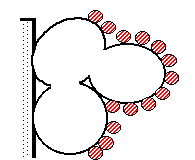
 Adsorbed dyes photosensitize
colloidal electrodes
Adsorbed dyes photosensitize
colloidal electrodes
Another approach under active investigation is sensitization
of high surface area TiO2 semiconductor electrodes using
porphyrin derivatives and porphyrin polymers. The use of high
surface area semiconductors has recently led to remarkable improvements
in the efficiency of solar cells and allowed the use of simple
and inexpensive semiconductors such as TiO2. Since TiO2 is white
(i.e., it absorbs in the ultraviolet but not in the visible),
efficient collection of the solar spectrum requires sensitization
by a molecule absorbing in the visible. We have demonstrated that
our carboxyporphyrin derivative is an excellent sensitizer for
TiO2, rapidly injecting an electron into TiO2 with high quantum
efficiency. We are actively investigating various ways of attaching
a series of porphyrins to TiO2 electrodes. This approach also
uses the concept of directional electron transfer between porphyrins,
with an electron transfer gradient from aminoporphyrin to carboxyporphyrin
to TiO2.