Carroll, pp 241 - 245, # 1 - 3 , 6 - 8 , 10 - 12 , 17 - 19 , 22
1. One of the advantages of being able to calculate approximate coefficients for the NBMOs of odd alternant hydrocarbons is that it allows a prediction of relative reactivity. In general, the more delocalized an intermediate (whether it is a radical, cation, or anion), the more readily it will be formed. Recall that it is the NBMO that determines the location of the charge or unpaired electron density in an odd alternant hydrocarbon radical or ion.
Consider the SN1 reactivity at various alkyl groups. For methyl, the ultimate odd alternant hydrocarbon (with only one p orbital, the NBMO coefficient is 1. For allyl and other delocalized cations, the NBMO coefficient is lower.
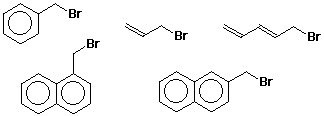
Calculate approximate NBMO coefficients for the appropriate intermediates to predict the relative order of reactivity of these alkyl halides.