Introduction
In two previous papers (Rueter part 1, Rueter part 2) I describe how the structure of the information in a course was important for designing and assessing the course. The first paper focuses on the structure of the course as viewed by scaffolding the resources and activities of students. The second paper describes how to use a database to follow individual students' performances on assessments, assignments and quizzes.
In this paper, I am examining the structure of the information in the discipline and the relationship of that structure to teaching. Each discipline has its own structure. The structure starts at the top levels with generally recognized descriptions of the domain of that discipline and sub-disciplines. For interdisciplinary programs, the structure may be determined by either the intersection or the joining of other disciplines. Within each discipline the courses carve out identifiable pieces or levels. Faculty understand these levels and may find them valuable for definition of their role. Students need to understand these details as they relate to the curriculum and graduation.
Within the constraints of one course or a course series there is also a more specific structure of the information. It is important for faculty to have a clear view of possible structures of this information in order to design learning activities and assessments as described in the previous two papers. It is also important for an academic to understand how experts construct the information in their discipline such that it serves their purposes, i.e. how do experts view the concepts and tools so that they can approach and solve problems? Students shouldn't be expected to learn this structure as a description of the information on its own, but rather they should be expected to assemble their own versions of this structure based on their experience using that information in the course. This is an important difference between the instructor and the students; the instructor already owns this construction and the students are trying to build it for themselves. The instructor's job should be more in planning activities that will help the students build this understanding, than it is to impart the structure. Nonetheless, students need to understand that the information should feel like it has a structure to them and that there are preferred structures that experts find useful.
This paper presents several activities that could be used in any course to help students construct a working structure for themselves. There are some levels of dealing with the information that will be inherently more difficult, these will be explored in relationship to a general structure of information that could be applied to any discipline. Finally, the case is made for the instructor's responsibility in the teaching/learning process which requires an understanding of the structure of the discipline and the ability to pose problems to students that force them to work with the concepts and skills with increasingly sophisticated combinations.
Particular cognitive activities for students
In any content domain there are several types of actions that students will have to perform with the concepts and skills.
association: Students need to be able to make simple one-to-one, one-to-many or many-to-one associations between concepts and simple skills. For example, in Environmental Science students need to be able to associate the concept of energy with heat, but also the many-to-one association of f coal, oil, and natural gas with the single category of fossil fuels.
These associations are usually taught and learned in a very straight forward manner. It is important for students to be able to identify a large number of these concepts and associations in all disciplines. Students are really using a search strategy to identify associations. If they have developed a structure for the information on their own they should be able to retrieve more useful information. As the concepts and skills become less and less closely related the structure becomes more important and the reliance on dragging through their memory becomes more futile. Although association is thought to be a base level cognitive skill, the ability to connect more distantly related concepts requires search strategies, selectivity, iteration, and cognitive load.
cognitive flexibility: Some concepts and skills are presented in interchangeable forms. Cognitive flexibility is the ability to be literate in these multiple forms. For example, the same information can be presented in words (temperature in degrees C vs. temperature in degrees F), as an equation T C = (TF - 32)*5/9, as a table or as a graph. Experts "see" all of these forms as interchangeable, and switch between formats seamlessly.
Table 1. "Cognitive flexibility" exercise example. The instructor would prepare similar grids with different cells missing.
verbal algebraic chart table The temperature in Celsius goes from 0 at freezing to 100 at boiling. The temperature in Fahrenheit goes from 32 at freezing to 212 at boiling.
C F 0 32 25 68 39 98.6 100 212
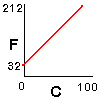
This type of cognitive flexibility can be taught using scaffolding. Students
can be lead through examples in which the same information is presented
in multiple formats with an explanation of each form. Then they can be
given examples that are missing different forms of the information and
then the instructor can provide only one form of the information and have
students develop the other formats. A common test for understanding these
skills are mixed format "story" problems in which the student
has to identify what information that they need and then recognize that
that information is available in one of the formats.
abstraction/application: These are complementary processes that should be learned together. Abstraction can be the simple categorization of concepts into larger categories and application can be simply applying the rules of a general category to a specific example. Many problems however require changing the form of the information at different levels of abstraction. This may be verbal to algebraic or there may be logical structures that are used. Table 2 lists some of the representational transitions that students might be expected to make. The instructor needs to be explicit about the need for these transitions and the value of multiple representations.
Table 2. Representational changes involved in abstraction and application
- Standard English
- discipline specific use of English words
- other human languages
- computer languages
- symbolic
- iconic
- abbreviations
- acronyms
- graphical
- numerical
In Environmental Science much of the abstraction has to do with mathematics. Students are expected to develop an appreciation for the similarity of underlying processes by seeing the similarity in the mathematical descriptions of these processes. Then when they see a problem that deals with a certain set of concepts or a particular "form" they are expected to apply the mathematical approach to this problem. Learning to interact with information in this manner requires many examples and extensive practice.
The ability to make abstractions or to apply abstract processes to a problem is assumed to be taught in mathematics. I don't think the students learn this well enough in these courses that they can apply them in a separate discipline. This seems to be a major stumbling block for many students. I think this difficulty illustrates the different views of the structure of information between the students and the faculty. The faculty understand the structure of the problems in their discipline and try to teach the students that structure, which they see as how to apply the mathematics. The students never really learned the art of abstraction in their math courses. They were too busy learning the algebra, statistics or other content in those classes. The faculty need to construct activities that help the student
Dealing with the information spectrum
Past these simple cognitive operations that students and experts perform, it is impossible to describe the structure of information that holds for all disciplines. This is simply because there is no structure except what is constructed in the minds of those in the field. The structure is a function of the tools that these people apply to that information and the tools themselves are part of the structure. Disciplines and the people in that field favor particular structures that spill over into their nonacademic lives as "world views". We all know that it is easy to spot a historian or scientist in a faculty discussion.
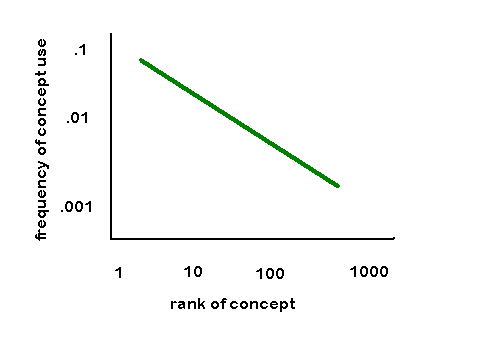
There is, however, a general feature of any information in any field that is important for teaching and learning. I am hypothesizing that, in any field, the rank of the use of concepts is related to the frequency of the use in a power function (Figure 1). This spectrum represents a scale independent characteristic. The information is organized in a manner that resembles criticality in other systems. As new concepts are added, they are added to the framework.
needs some more detail here
The process that leads to this relationship represents the construction of new understanding in the discipline. Imagine a field of concepts that are unrelated by processes. As these concepts are used to solve problems, they become associated. In every case, the context for the problem must be set and explained. New wrinkles in the interpretation require continual redescription of the context. A new concept at the bleeding edge of the field actually reinforces and propagates the mentioning of the broader concepts.
Figure 1. Proposed general relationship between the rank of a concept and the number of times that concept appears in a comprehensive textbook for the major. This power law relationship represents the organization of information at the edge of criticality.