Association of Concepts
association: Students need to be able to make simple one-to-one, one-to-many
or many-to-one associations between concepts and simple skills. For example,
in Environmental Science students need to be able to associate the concept of
energy with heat, but also the many-to-one association of f coal, oil, and natural
gas with the single category of fossil fuels.
These associations are usually taught and learned in a very straight forward
manner. It is important for students to be able to identify a large number of
these concepts and associations in all disciplines. Students are really using
a search strategy to identify associations. If they have developed a structure
for the information on their own they should be able to retrieve more useful
information. As the concepts and skills become less and less closely related
the structure becomes more important and the reliance on dragging through their
memory becomes more futile. Although association is thought to be a base level
cognitive skill, the ability to connect more distantly related concepts requires
search strategies, selectivity, iteration, and cognitive load.
Dealing with the information spectrum
Past these simple cognitive operations that students and experts perform, it
is impossible to describe the structure of information that holds for all disciplines.
This is simply because there is no structure except what is constructed in the
minds of those in the field. The structure is a function of the tools that these
people apply to that information and the tools themselves are part of the structure.
Disciplines and the people in that field favor particular structures that spill
over into their nonacademic lives as "world views". We all know that
it is easy to spot a historian or scientist in a faculty discussion.
There is, however, a general feature of any information in any field that is
important for teaching and learning. I am hypothesizing that, in any field,
the rank of the use of concepts is related to the frequency of the use in a
power function (Figure 1). This spectrum represents a scale independent characteristic.
The information is organized in a manner that resembles criticality in other
systems. As new concepts are added, they are added to the framework which makes
links back to more common terms. The process that leads to this relationship
represents the construction of new understanding in the discipline. Imagine
a field of concepts that are unrelated by processes. As these concepts are used
to solve problems, they become associated. In every case, the context for the
problem must be set and explained. New wrinkles in the interpretation require
continual redescription of the context. A new concept at the bleeding edge of
the field actually reinforces and propagates the mentioning of the broader concepts.
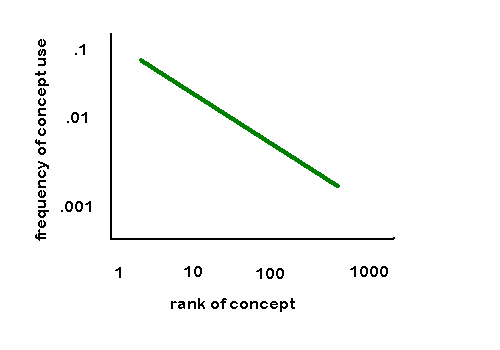
Figure 1. Proposed general relationship between the rank of a concept and
the number of times that concept appears in a comprehensive textbook for
the major. This power law relationship represents the organization of information
at the edge of criticality.
The relationship between rank and frequency can be tested by using general
text books for the environmental sciences. The following graphs show the log
of the rank on the X axis versus the log of the frequency for index terms in
the textbooks. Terms that had at least three entries, i.e. showed up at least
three different places in the book were recorded. The total number of entries
was summed and the ranks and frequencies were calculated. The books chosen for
this analysis represent a range of texts that might be used in an Environmental
Science program, from introductory non-majors to upper division texts.
The texts chosen were:
Miller - non-majors
M&S majors
Ricklef - ecology text
WMH upper division text
Schlesinger
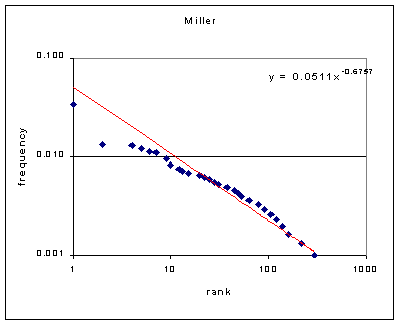
Figure 2. Frequency and Rank relationship for Miller.
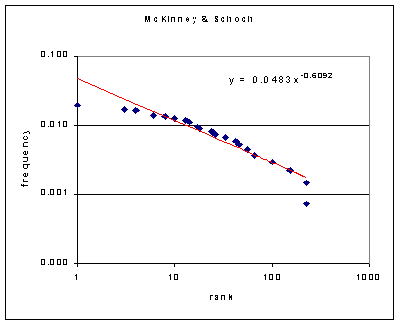
Figure 3. Frequency and rank relationship for McKinney and Schoch.
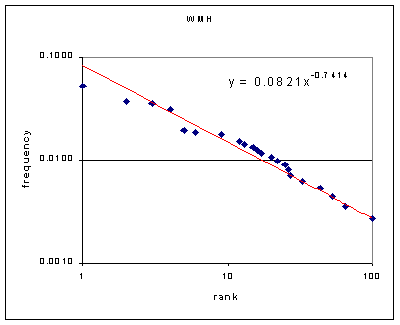
Figure 4 Frequency and rank relationship for WMH
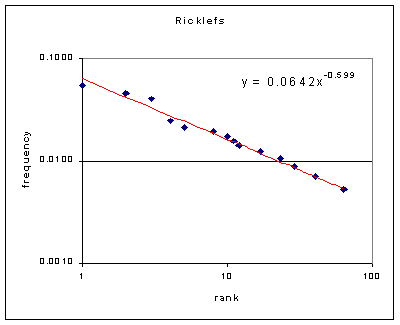
Figure 5. Frequency and rank relationship for Ricklefs.
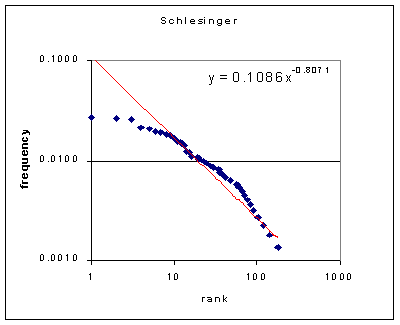
Figure 6. Frequency and rank relationship for Schlesinger.
All of the texts fit with the hypothesized relationship fairly well. The most
common term in each text is less than expected. In Miller (****) for example,
the most common term is "United States" which is pretty close to the
line. Many concepts are related to the term "United State" including
laws, society, and comparisons to other countries. There is a tie for second
rank between "agriculture" and "forest" which might put
them both a little below the line.
Relationshipi between courses
In the curriculum, one course is supposed to prepare the students for the subsequent
courses in the sequence. It should be expected that the majors Environmental
Science text book would lay the foundation for future concept building in the
discispline.Figure 7 illustrates the hypothesized relationship.The survey courses
would focus on the most common concepts but a specialty course would link to
and build on these central foundation concepts. The upper division courses would
contain some of the same concepts that are in the introductory courses, but
would select a subset of the terms that were rare in the introductory course
and use them more frequently, i.e. specialize in one area.
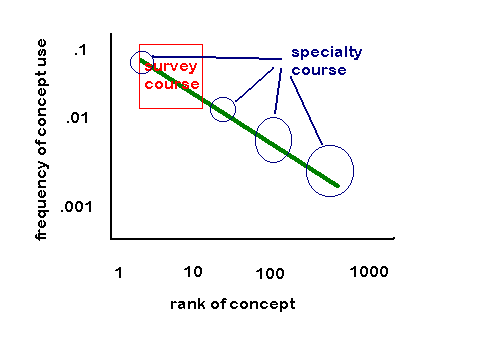
Figure 7. Teaching strategies as they relate to the rank and frequency of
concepts.
The data comparing the majors text to the two upper-division texts partially
illustrates this relationship but it is very interesting to note the very low
overlap in terms in the index. The overlap between M&S and MWH was only
4.9% and the overlap between M&S and Schlesinger was only 0.3%. M&S
had 221 terms in the index that showed up in three or more places in the text.
The index sizes for WMH and Schlesinger were not much smaller, 175 and 208 respectivley.
The overlap means that only 20 terms showed up (at 3 or greater) in both the
indices of M&S and WMH and 37 terms were in both M&S and Schlesinger.
. The concepts that overlap between the introductory texts and the upper division
texts follows the desired relationship as illustrated but there is a major weakness
in this, the frequencies of these concepts in the upper division texts are not
related to the frequencies in the introductory text. This means that the upper
division texts are not relating these concepts back to a common framework, but
rather looking at it from a different view of the discipline. This indicates
that these texts are not optimally aligned, the introductory course should have
more overlapping terms, but the frequencies should be different
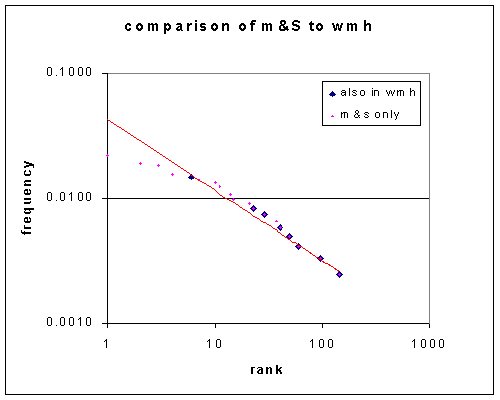
Figure 8. Frequency and rank of M&S with concepts that overlap with WMH
indicated by larger squares. The order of the rank of these concepts in WMH
is not related to the rank in M&S.
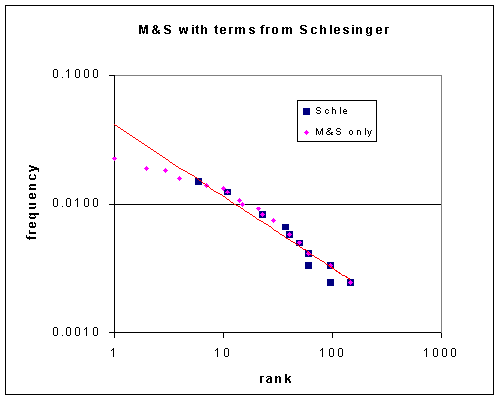
Figure 9. Frequency and rank of M&S with the concepts that overlap with
Schlesinger indicated by the larger squares.The order of the rank of these
concepts in Schlesinger is not related to the rank in M&S.
Approaches to teaching
The consequence of this fractal dimension of concept/skill space is that we
need to develop activities for students that intentionally probe the different
ranges in this space and have a range of scales. For example, a survey course
for non-majors may focus on the top 25 concepts in the field and the relationships
between those concepts. A introductory course for majors may hit the same 25
concepts but should also include some exploration of some rarer concepts to
set the example of how concepts are related. The practitioner in the discipline
will have to deal with the wide range of concepts.