Introduction
Available technology has allowed us to develop a new set of teaching strategies that can be added to some current classes or drastically modify future courses. One type of modification that I think will be particularly valuable to faculty and students is to mix face-to-face and technology strategies in providing a course that provides more "flexibility" in the format. In particular, using face-to-face time sparingly and replacing some of the specified class time with exercises and activities on the internet looks promising. This article will address the benefits to learning and learning, and compare the cost of constructing a flexible format course.
Increased student learning outcomes
Dianna Laurillard has stated that the use of technology in courses is not about multimedia but about multiple media (Laurillard 1993). By designing a course to use both a face-to-face format and technology format greatly increases the choices of media and teaching/learning strategies that can be employed. We have used multiple strategies in large lecture courses, many of which could also be delivered via the web. Individual students use these multiple strategies in different ways, leading to nebulous and overlapping categories that we call "study styles".
What we are trying to do by offering a range of strategies is to help students invest their time and attention in activities that will help them learn the material. These activities include reading, listening to lectures, working on problems, discussion, written exercises, entering into a dialog, presentation and other strategies. For each of these activities, student time on task should relate to student learning outcome. We are interested in the learning effectiveness of these activities, how much they learn compared to how much time and effort they spend on that activity. Learning effectiveness may not be simply linear (Figure 1). Short time on task may not result in much learning on the topic and too much time on that same task should lead to diminishing return (because they already learned the material). We need to craft the activities to get students to realize the maximum return on their invested time. We need to focus our efforts on several different strategies and help or guide each student to use these strategies efficiently.
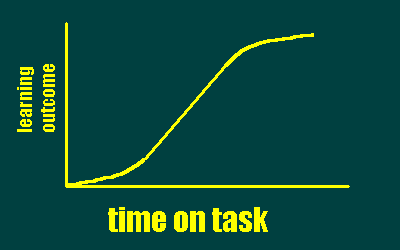
Figure 1. The relationship between the time on task on a single activity for a single learning goal, compared to the amount a student learns.
The relative use of these different strategies is an important consideration. It should be expected that some strategies can be substituted for others, some might be more efficient than others and finally that the some strategies might have a synergistic relationship. This is a problem of resources and how effectively they are used for growth (Tilman 1982). In this case the faculty create the resources to go along with their teaching/learning strategies and students use these resources, with different effectiveness, to learn. Several scenarios can be presented graphically for comparison.
If one resource can be substituted for another then we could expect an outcome as seen in Figure 2a. This indicates that the students expenditure of time on either resource will be just as effective and that the resources can be mixed. Two resources that share this type of relationship might be listening to a lecture and reading the book.


Figure 2. a) Substitutable resources that have the same effectiveness. The diagonal lines represent increasing student learning outcomes as the student spends more time studying. b) Substitutable resources in which resource1 is more effective than resource 2, i.e. it takes a student less time using resource1 to learn the same amount.

Figure 3. Synergistic resources or strategies. The use of the combination leads to greater learning outcome than the same combination in Figure 1.
Increased faculty productivity
By my definition, increased student learning is an increase in teaching productivity, maybe the most important increase. The issue is how to increase the number of students and the level of quality of their learning.
A major trap in all of technology based education is the amount of extra time it takes to develop the different media and resources that support the teaching/learning strategies. My personal experience with this is in General Biology where I spent a large amount of time developing several internet tutorials. Although these resources lead to signigicant increases in learning outcomes, I wouldn't have had time to develop similar resources for every concept in every unit.
References
Diana Laurillard, 1993. Rethinking University Teaching: A framework for the effective use of educational technology. Routledge.
John Rueter and Nancy Perrin, 1998. Assessing the Effectiveness of Multiple Strategies. TLTR meeting.
David Tilman 1982. Resource structure and community structure. Princeton University Press.