Timeseries decomposition transforms a single timeseries into multiple, component time series. These help us to extract seasonality information and trend easily. There are two basic forms of seasonality: additive and multiplicative.
An additive decomposition applies when the seasonal variation is constant. As the timeseries value increases the seasonal effect remains the same. With a multiplicative timeseries, the seasonal fluctuations continue to grow (or diminish) as time moves foreward. Essentially the seasonal pattern becomes amplified as time moves forward.
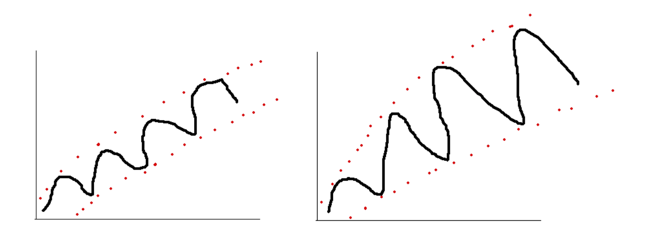
The following figure illustrates the two forms of seasonality, both imposed on an upward trend.
For the additive seasonality pattern on the left, the dotted red lines maintain a consistent distance apart throughout. The magnitude of the seasonal spikes do not change as the trend increases.
For the multiplicative seasonality on the right, the seasonal variation becomes more pronounced as time moves forward. Accordingly, the dotted lines become further and further apart over time. This is an example of a multiplicative seasonal timeseries.