| Sample software | last modified: |
Çfarë thatë? - Introductory Albanian for Proficiency is based on the pedagogical approach of two introductory language programs: Wie, bitte? - Introductory German for Proficiency and ¿Cómo? - Introductory Spanish for Proficiency. Both programs were originally published as conventional ink-on-paper textbooks, though even then they were accompanied by computer-based resources. Starting in the 1990s, Wie, bitte? and ¿Cómo? were transformed into computer-delivered programs. The software that supports them is a "shell" program which is now being used to deliver Wie, bitte? The software has been in use as the main and, since 2003, only medium of delivery for first-year German at Portland State University. There is no printed textbook, though key text files are offered as printable PDFs.
To see what the Çfarë thatë? will resemble, you can download the demo version of the program, or excerpted versions of the Wie, bitte? and ¿Cómo? software. There are Macintosh and Windows versions for each.
For Çfarë thatë? there are two chapters: #12 "At the local market" and #25 "Getting medical help." Visitors who do not undertand Albanian can still explore the program, since the interface language is English. The current version (3 May 2009) does not yet have its dialog sounds; but it does have its broadcast audio segment and a representative collection of graphics. A revised version, with dialog sounds, should be availabe by 10 May 2009.
The excerpted versions of Wie, bitte? and ¿Cómo? have a sample unit about buying supplies for a day trip. The unit corresponds to unit #12 of Çfarë thatë?, which you can also see as text display (no media) by clicking on the "Sample lessons" link to the left. The Wie, bitte? program has more resources than the ¿Cómo? program. Çfarë thatë? will have all the features of Wie, bitte?
Directions:
1. The files are quite large, so you should download them over a fast (broadband) internet connection. That will probably take almost half an hour for either file over a home broadband connection. The files download in compressed form ("zipped"), so you may have to "unzip" them manually, if your computer is not set up to do that automatically.
2. After you have downloaded and unzipped the sample, look in its folder / directory. You will see a master file whose names starts with either "Como" or "WieBitte". Click on it to start the program. Leave the folder / directory "media" alone - don't open it, and don't move it to another place.
3. You will see the "opener" screen (see below for Çfarë thatë? and ¿Cómo? - click on the pictures to see them at full size in separate windows). All the buttons on it are functional, but many will lead to links to resources that, to keep the file size down, have not been included in the sample software. Sometimes a space for a picture will simply be gray, or a sound controller will be dead. To tour the units for which most resources have been included, use the "Choose Context" menu button to select "08 Reiseproviant" (Wie, bitte? for German) or "07 Algo para el viaje" (¿Cómo? for Spanish).
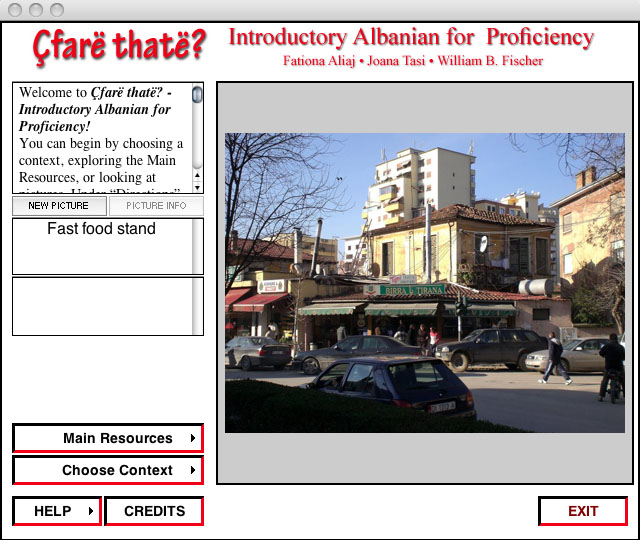
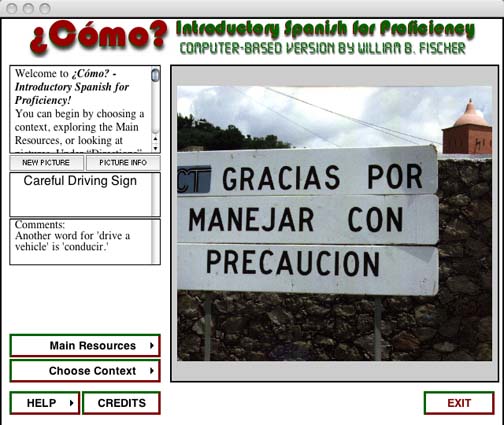
If you want to examine the full versions of either or both Wie, bitte? and ¿Cómo?, email your request to Dr. William B. Fischer <fischerw@pdx.edu>. Include your postal (snail mail) address. You will receive the CD-ROM(s) free of charge.
To see the website that supports first-year German at Portland State University, where Wie, bitte? has been in use for 20 years, follow this link, and then the link from that page to "First-year German (GER 101/102/103). The links "Schedule & Assignments" lead to links where you can download sample tests, projects, and scoring guides like those that will be developed for Albanian.