|
|
|
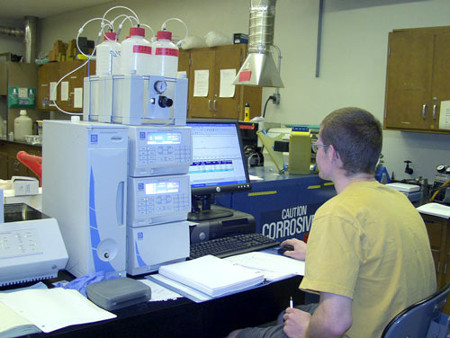
Department of Geology TRACE ELEMENT ANALYTICAL LABORATORY The Trace Element Analytical Laboratory, operated by the Department of Geology and located in Cramer Hall Room 43, provides inorganic analytical support for researchers from throughout PSU. |
Instrumentation
ICP-MS Applications
|
 Laboratory
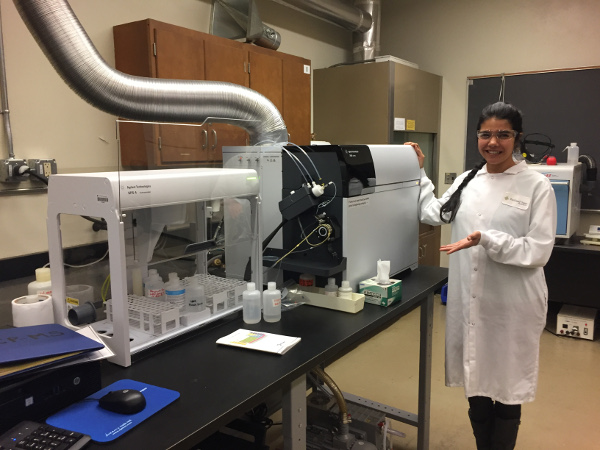
Technician Alexandra Franco in front of the Agilent 7900 Laboratory
Technician Alexandra Franco in front of the Agilent 7900Inductively Coupled Plasma Mass Spectrometer
|
For inquires regarding analytical capabilities, sample preparation, or scheduling and pricing, contact Ben Perkins:  Telephone: (503)
725-3387 Mailing Address
FedEx / UPS Street
Address
|
The lab houses the following instrumentation:
Agilent 7900 Inductively Coupled Plasma Mass Spectrometer (ICP-MS)
Dionex ICS-2500 Ion Chromatograph (IC)
Beckman Coulter DU 730 Spectrometer
Milestone Ethos series closed-vessel microwave digester
Laboratory Fee Schedule:
ICP-MS: Academic Users, unassisted: $60 per plasma hour
ICP-OES:
Academic Users, unassisted: $43 per plasma hour
ICP-MS: Outside Users - Contact Lab to discuss your needs
IC: Academic Users, unassisted: $20 per pump hour
Assistance (including sample preparation, training): $50 per hour
ICP-MS Applications:
ICP-MS can generate high-quality trace-level (sub-ppb) concentration data for elements with a wide range of atomic masses from 6Li to 238U. The best results are obtained for elements that have ionization potentials well below that of the carrier gas (Ar, 15.8 eV) and that are free of isobaric interferences. Our current setup precludes analyzing anything other than solutions. Analyses of soils, rocks, and other solids thus requires that samples be dissolved (e.g., via strong acid digestion). Solution samples submitted for analysis should be free of solids and elevated concentrations of organic compounds. Ideally, they should be in a matrix of 1-3% HNO3. Other matrices, including HCl, may be problematic in terms of signal response (e.g., viscosity differences affecting nebulization efficiencies, matrix components affecting plasma chemistry or inducing space charge effects) and interferences. For these reasons, accurate analyses of solutions that are not in a dilute HNO3 matrix require matrix matching with standards and or use of standard addition calibration. Reagents used for sample preparation should be doubly distilled or ultrapure where possible. Samples that have high concentrations (> ppm) of analytes should be diluted. A minimum of 10 ml should be submitted for analysis.
Standards: Ideally these will be prepared from single- or multi-element commercial stock solutions. Typically, we utilize 3 to 6 external standards that bracket expected sample concentration range. In addition, we recommend that internal standards be utilized to account for variations in instrumental response as the analysis proceeds (drift). Internal standards (IS) are elements (e.g., Y, In, Bi) that would have negligible concentrations in sample and that do not cause isobaric interferences with analytes; they are added to all blanks, standards, and samples and the analyte:IS ratio is used to calibrate.
Blanks: Procedural blanks should be prepared by the same method used to prepare the unknowns. If the unknowns have not been processed by any digestion method, the blank would be diluted acid similar in concentration and character to that in the unknowns. Blanks will be run initially to check the cleanness of sample preparation procedures.
Quality Control Samples: These are samples of known concentrations, but prepared separately from (ideally with different stocks and by different people) calibration standards and are used to check the accuracy of the calibration and to track instrumental drift. Commercial QC samples are available.