Everything in this box is directly from the PSU Library Write and Cite page: Plagiarism and Copyright The idea of research is to study what others have published and form your own opinions. When you quote people -- or even when you summarize or paraphrase information found in books, articles or Web pages -- you must acknowledge the original author. If you use someone else's words or ideas without crediting them, you are committing a type of theft called plagiarism. Plagiarism can be as obvious as turning in another person's paper or project as your own, or as sly as simply paraphrasing sections of various works. It is also incorrect to copy text from Web pages or other sources without identifying where they came from. How can you avoid plagiarism?
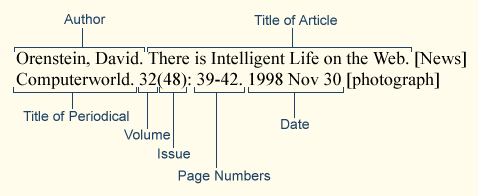
Citing Your SourcesCiting : noting the source of a quote, paraphrase or Citing is the process of giving credit to the sources you used to write your paper. Citations can be located in the text or at the end of the work in a bibliography. It can be difficult to figure out what needs to be credited. Use this rule : If you knew a piece of information before you started doing research, generally you do not need to credit it. You also do not need to cite well-known facts, such as dates, which can be found in many encyclopedias. All other information such as quotations, statistics, and ideas should always be cited in your papers. As you create your list of cited sources, it is helpful to know what type of information you need to write down. Here is a citation from a periodical index with each of its important parts labeled.
Formats for citing are consistent so that other researchers may quickly identify the sources you used and easily locate them. To find the guidelines for a particular format you will need to look in a style manual. Your instructor will probably recommend a particular style manual such as APA, MLA or Chicago Manual of Style . Each style manual format includes the same basic parts of that citation, but may organize them slightly differently. The Library keeps copies of all of the major style manuals at the 2nd floor reference desk. Many style guides are also online. For more on citation styles, check out the PSU Writing Center's Resources Page
|
Additional Resources:
PSU's Writing Center page on citations
http://www.writingcenter.pdx.edu/resources/apa.html
The Center's main page: http://www.writingcenter.pdx.edu/. Go here for help on writing.
Electronic sources: http://www.writingcenter.pdx.edu/resources/electronic.html
Humboldt State University Library: A good overview of options and links
http://library.humboldt.edu/~rls/bibdata.htm
Dartmouth University: Sources: Their Use and Acknowledgement (a comprehensive source)
http://www.dartmouth.edu/~sources/
The American Psychological Association's Publication Manual is often used as the standard for citations and references:
Main page: http://www.apastyle.org/
Tips:
http://www.apastyle.org/previoustips.html
Electronic references: http://www.apastyle.org/elecref.html