|
|
|
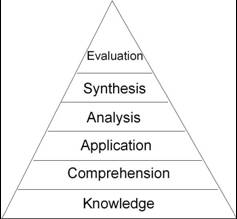
Bloom’s Taxonomy has 6
levels – (read and define)
|
|
Knowledge: Recall data or
information.
|
|
Comprehension: Understand
the meaning, translation, interpolation, and interpretation of instructions
and problems. State a problem in one's own words.
|
|
Application: Use a concept
in a new situation or unprompted use of an abstraction. Applies what was
learned in the classroom into novel situations in the work place.
|
|
Analysis: Separates material
or concepts into component parts so that its organizational structure may be
understood. Distinguishes between facts and inferences.
|
|
Synthesis: Builds a
structure or pattern from diverse elements. Put parts together to form a
whole, with emphasis on creating a new meaning or structure.
|
|
Evaluation: Make judgments
about the value of ideas or materials.
|
|
These are generally viewed
hierarchically – in comprehension is built on knowledge, etc. Thus the
“lower” levels are often basic skills and the upper levels more advanced.
|
|
|
|
Not all people who use this
taxonomy view it hierarchically --
some view it circularly.
|
|
|