|
1
|
- Lynn Santelmann, Ph.D.
- Applied Linguistics
- Focus on Faculty,
- September 19, 2007
|
|
2
|
- Functions of the Syllabus
- Elements of a Syllabus
- Relating your syllabus to teaching
- Using your syllabus to improve teaching and learning
|
|
3
|
- What are some functions
- of the syllabus?
|
|
4
|
- Course planning
- Describes required materials
- Describes schedule of events
- Point of contact between instructor and students
- Lays out logistics for contact
- Sets tone for course
- Contract between students and instructor
- Establishes expectations
- Establishes responsibilities
|
|
5
|
- Explains available resources
- Books, library or other campus resources
- Electronic resources (e.g., Web resources)
- Resources for students with disabilities
- Puts course in a larger contexts
- Communicates your approach to the course
- Places course in university/department context
- Tool for reflection on your courses
|
|
6
|
- Take a look at your syllabus (or my novice syllabus if you don’t have
one of your own)
- What information do you include?
- What is their function?
- Do you see any functions “missing”?
|
|
7
|
- Basic course information
- Course name/number, credits
- Course meeting times/locations
- Contact information - phone, office, e-mail
- Office hours for professor (and
TAs)
- Textbooks/Readings to be used
- Other resources used (e.g., online)
- Course prerequisites
- Course description (detailed)
|
|
8
|
- Content and Assignments
- Course Objectives
- Student Learning Outcomes
- Description of Assignments
- Weighting of Assignments
- Evaluation and Grading Criteria
|
|
9
|
- Schedule of Readings and Assignments
- Make sure you add ‘tentative’ or ‘subject to change’
- Policies and Administrative Details
- Late assignments
- Student conduct (classroom behavior & plagiarism)
- Important Dates - drop/add, due dates, exams
- Statement for students with disabilities
- Other information specific to your course
|
|
10
|
- Participation During the quarter, you will be regularly asked to
contribute to the group as a whole. In addition, you will be asked to
participate in small group problem-solving or discussions. These
activities are important for your learning of the material, so
participation and attendance are critical. In addition, these activities
will require you to come to class prepared. I monitor participation and
note who appears to be prepared or not.
- Participation will be graded on:
- a. Regular attendance
- b. Being prepared you are for the class
- c. Appropriate contributions to both small and large group discussion,
- d. Ability to respond appropriately to classmates' questions, comments
and discussion.
- Appropriate contributions includes:
- a. monitoring the tone and the amount of your own speech
- b. allowing others a chance to speak and facilitating others'
contributions
- c. plus other definitions we may develop as a class throughout the
quarter.
|
|
11
|
- Regular attendance and appropriate contribution to only small groups
will earn a "C".
- Regular attendance and appropriate contribution to both large and small
groups will earn a "B". To earn a "B" aim for one
contribution per large group discussion.
- Superior participation in both large and small groups will earn an
"A". More participation does not guarantee an "A".
"A" participation includes monitoring your own and
facilitating others' discussion.
- Irregular attendance and/or failure to participate in discussions will
earn a "D" or lower.
- Consistent inappropriate contributions will be penalized by one letter
grade or more. I will inform you in private if I think your
contributions are inappropriate before lowering your grade.
|
|
12
|
- Policy on Late Assignments
- If you are seriously ill or have a family emergency, you must notify me
as soon as you know there might be a problem with meeting a deadline. My
voice mail and e-mail both work 24 hours a day, so you can call or send
a message at any time. If I know 48 hours ahead of time that you need to
be late with an assignment, I can try to be flexible. I will be less
flexible after the fact, and apply my late policy strictly (see below).
If you miss a deadline due to an emergency, I will need a written
confirmation (on letterhead) of what the problem was.
- The on-line quizzes will only be available for a short period of time
(about 3 days). You must take the on-line quiz during this time. No
make-ups will be possible, except in cases of emergency as described
above.
- Late exams/papers will be penalized a letter grade per day (i.e. B to
B-). Exams or papers more than 4 days late will not be accepted. NOTE:
WEEKENDS COUNT AS 2 DAYS. Thus, if an exam is due on Friday and you turn
it in on Monday, that essay is 2 days late!
|
|
13
|
- Sample syllabus statements for students with disabilities:
- "If you have a disability and are in need of academic
accommodations, please notify me (the instructor) immediately to arrange
needed supports."
- "If you are a student with a documented disability and registered
with the Disability Resource Center, please contact me (the instructor)
immediately to facilitate arranging academic accommodations.“
- Disability Resource Center Faculty Resources:
http://www.pdx.edu/uasc/drc_faculty_resources.html
|
|
14
|
- Course Planning & Design
- Course Objectives vs. Student Learning Outcomes
- Assessment & Grading Criteria
|
|
15
|
- Develop a rationale for the course
- Decide what knowledge, skills or ideas students should take from the
course
- Choose limited course content
- Determine how students will be actively involved in their learning
- Identify resources, readings
- Develop a schedule
|
|
16
|
- Prior syllabi in the department, your experience
- On-line syllabi from other institutions (e.g., World Lecture Hall,
Google)
- Textbooks
|
|
17
|
- What are Course Objectives?
- What the instructor wants to achieve
- Sample: “To become familiar with the major theories of language
development and some of the major debates in field”
|
|
18
|
- Tend to be teacher-focused
- Tend to be abstract:
- How do you know whether students have achieved the course objectives?
- How do your students know whether they have achieved these objectives?
|
|
19
|
- What’s the difference between course objectives and student learning
outcomes?
- Student learning outcomes = operationalized course objectives
- Student learning outcomes can be measured
|
|
20
|
- Course planning
- What knowledge or skills will students demonstrate after taking this
course?
- How will I assess this knowledge?
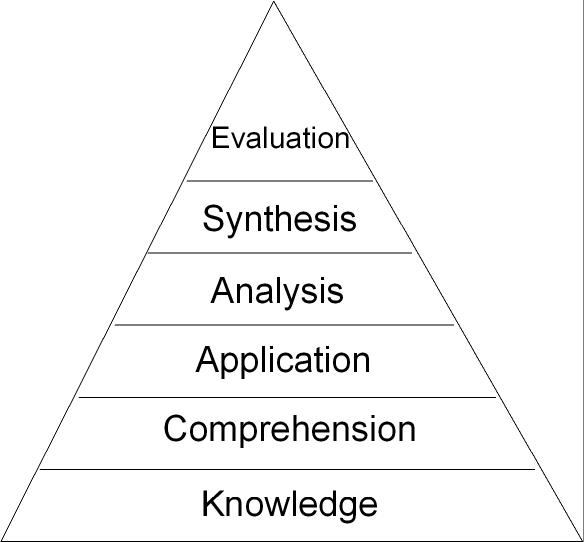
- Taxonomies of learning, e.g., Bloom’s Taxonomy of Cognitive of Cognitive
Levels
- Bloom B. S. (1956). Taxonomy of Educational Objectives, Handbook I: The
Cognitive Domain. New York: David McKay Co Inc.
|
|
21
|
- Knowledge
- Comprehension
- Application
- Analysis
- Synthesis
- Evaluation
|
|
22
|
- Knowledge
- define, identify, list, label, match, name, state, write
- Comprehension
- describe, explain, give examples, illustrate, paraphrase, summarize
- Application
- apply, compute, construct, demonstrate, solve, use
- Analysis
- analyze, categorize, compare, contrast, separate
- Synthesize
- create, design, develop, hypothesize, plans, invent
- Evaluate
- argue, critique, evaluate, judge, justify, rank, recommend
|
|
23
|
- Course objective:
- “To become familiar with the major theories of language development and
some of the major debates in field.”
- Related student learning outcomes:
- Describe the underlying assumptions and aims of 3 current theories of
child language acquisition. (Comprehension)
- Compare and contrast different theories of child language
acquisition. (Analysis)
|
|
24
|
- 5 minutes
- Take one of your course objectives, and create one or two student
learning outcomes for that objective.
- Keep in mind what student will
have to demonstrate to show that they have achieved it (see verbs on
handout)
|
|
25
|
- Relating content to objectives & outcomes
- Planning course for variety of learning styles, activities
|
|
26
|
|
|
27
|
- What activities encourage active learning?
- How do my activities fit with different learning styles?
- How do my activities and my course structure fit with my
educational/course philosophy?
|
|
28
|
|
|
29
|
- Grading Criteria: Explicit guidelines telling students how their work
will be evaluated
- Adding grading criteria to the syllabus helps:
- Links assessment to learning outcomes
- Clarify assignments for you and students
- Focus instruction and class time on what you consider important
|
|
30
|
- My students complete qualitative work, I can’t come up with a specific
criteria
- What do they want, me to spoonfeed the students? I shouldn’t have to tell
my students how they’re being graded.
- I know an “A” paper when I see one
- That will just foster “teaching to the test”
|
|
31
|
- Student evaluations consistently rated “grading criteria clearly
defined” lower than other aspects of my teaching.
- Dissatisfaction with grades I was giving.
- “Why is this a B paper?”
|
|
32
|
|
|
33
|
- Homework assignments and exam questions involving problems will be
graded on a point scale. An A or A- will fall between 91-100% of the
points, a B+, B, or B- will fall between 90-81% of the points, a C, C+,
or C- will fall between 80% and 71% . Note: Students in 511 must receive
83% or better to satisfy the syntax requirement for the MA degree.
- For homework and exams that require problem solving, points are
assigned according to the following criteria:
- 1. Difficulty of problem (more difficult problems will be worth more
points)
- 2. Demonstrating all steps involved in the problem solving process.
- 3. Accuracy of answers for each step.
- 4. Accuracy of final answer.
|
|
34
|
- I can more accurately identify what's 'missing' from papers or what's
'good'
- I uncovered several implicit criteria, e.g., discussing and comparing
theories
- We spent little or no classroom time discussing or comparing theories
- Student work improved
|
|
35
|
- Your syllabus is a living document:
- A tool for reflecting on your teaching and revising your course
- Should be constantly changing
- Doesn’t need to change overnight – you can implement changes as you’re
able
|
|
36
|
- A syllabus is more than a ‘contract’ or list of expectations and
assignments
- Clear expectations, criteria and plans improve the course for students
& instructor
- A syllabus is a tool for course planning, implementation and assessment
- Linking syllabus to specific student learning outcomes and grading
criteria can improve your course
|
|
37
|
- Resources for Planning, Teaching & Assessing your Teaching, Center
for Academic Excellence, Portland State University
- http://www.pdx.edu/cae/teaching_learning_resources.html
- Learning-Centered Syllabi Workshop, Center for Excellence in Learning
& Teaching, University of Iowa
- http://www.celt.iastate.edu/teaching/syllabi.html
- Syllabus/Course Design, Center for Excellence in Teaching, USC
- http://www.usc.edu/programs/cet/resources/creating_syllabi/
- Designing a Learning-Centered Syllabus, Center for Teaching
Effectiveness, University of Delaware
- http://cte.udel.edu/syllabus.htm
- Creating a Syllabus for the Learner-Centered Classroom, Teaching
Effectiveness Program, University of Oregon
- http://tep.uoregon.edu/workshops/teachertraining/learnercentered/syllabus/syllabus.html
- Community Based Learning Course Syllabus Design, Center for Academic
Excellence, Portland State University
- http://www.pdx.edu/cae/syllabi.html
- World Lecture Hall, University of Texas at Austin
- http://web.austin.utexas.edu/wlh/
|

 Notes
Notes